Long silent time. Not caused from any shortage of coffee or interest about science but the last few years my life have been quite weird. The revival of this blog should be short, just to discuss a few points about memetics.
During a 24h vacation from my actual preoccupations I came across a paper from Maarten Boudry (get a copy here) :
Replicate after reading: on the extraction and evocation of cultural information
Maarten Boudry, Biology & Philosophy (2018) 33:27 https://doi.org/10.1007/s10539-018-9637-z
My interest was triggered by a tweet: — Maarten Boudry (@mboudry) July 11, 2018
Old joke presented here and there are a few variants about its conclusion. I have use it to illustrate how the same stimulus may elicit different responses depending on the system under investigation and its receptors, say doxycycline used for expression of a transgene under a TetOn promoter and the role of the antibiotic on angiogenesis inhibition; that may be tricky if your transgene is also supposed to inhibit angiogenesis, right?
Anyway, I got a copy of Boudry’s paper and I started reading. The way I used the joke is contradicting the assertion on page 26:
For the system to work, every participant already needs all the jokes stored in memory, along with the corresponding numbers. This, of course, is the point of the punch line: if you start laughing, you must have heard the joke before.
Well…
Another Real World example to support my objection.is the evolution of the metabolic pathways producing THC; they didn’t evolve for recreational or medical use, right? Same stimulus, different receptor, different effect.
But that’s something to discuss about and it’s fun to start discussing about jokes. I’ll put that aside, maybe for later.
But than Boudry starts discussing about Sperber and on page 27 he cites from Sperber D (2000) An objection to the memetic approach to culture. In: Aunger R (ed) Darwinizing culture: the status of memetics as a science. Oxford University Press, Oxford, pp 163–173
In general terms, Sperber proposes three “minimal conditions for true replication”. For B to be a copy of A,
- B must be caused by A (together with background conditions)
- B must be similar in relevant respects to A
- The process that generates B must obtain the information that makes B similar to A from A.
Now, when you talk about true replication to a biologist you have his attention. Instantly. Of the various types of biological replication my favorite is the rolling circle some bacteriophages use. And it is used also for in vitro isothermal amplification. Certainly not the most common one, so I’ll stick with the more used one here.
Let’s examine the three points Sperber proposes for B to be a copy of A and if it’s possible to qualify DNA replication as true.
Point 1 is OK I think if we take in the background conditions the DNA polymerase, the dNTPs and a bunch of other stuff. I singled out the enzyme and the dNTPs because I want to discuss them below.
Point 2 is problematic. In fact, from a double stranded DNA molecule A we can obtain two double stranded DNA molecules indistinguishable from A (no mutations for the moment and the necessary machinerie to polish the ends of the molecules.) During the replication process, the DNA polymerase synthesise two DNA strands that are the reverse complement of the strand serving as matrix!
Because the two strands of the initial DNA molecule are antiparallel and each one the reverse complement of the other, because of that and only because of that, the two final molecules are similar. And the DNA replication being semi-conservative each of the two resulting molecules is composed by half of the initial one!
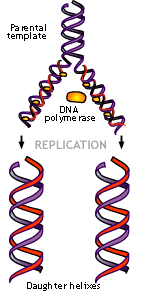
So, according to point 2 of Sperber’s DNA replication is not a true replication. I think that Meselson–Stahl or Crick-Watson would be quite sad to learn that.
Is it necessary to go to point 3? Probably not, we already know that we are in a GIGO situation here. But just for the fun of it and maybe for future use in a more appropriate set of rules let’s examine how the DNA polymerase knows what must be the next base to incorporate in the neosynthetised strand: it doesn’t.
The complementary base, able to establish the adequate number of hydrogen bonds with the one of the template (A::T or C:::G) will be correctly positioned to allow the catalysis of its incorporation. The DNA polymerase only sees that it is able to catalyse the formation of a new phosphodiester bond. That’s quite convenient when you need to incorporate to the neosynthesised strand some nucleotide analog, using say dig-dUTP an analog of TTP. And such altered DNA strands may be used as matrices to produce more canonical reverse complements later on.
So, what would true replication be?
We surely have information transfer from one object to other objects, in the case of DNA replication discussed above in the two resulting double stranded molecules. In other systems we may have transfer of the information in several other molecules. That’s what I like in the rolling circle replication system where a single matrix molecule is used to produce hundreds of daughter (reverse complement) strands each of them circularised and encapsulated in a virion in the replication of say filamentous phages.
Some times the information is stored in a similar medium (say DNA or RNA or PNA). Or it can be stored in a completely different medium: for genetic information in silico instead in carbon based molecules. I salute here Craig Venter and his team who brought us the proof of concept. So, the nature of the support doesn’t matter. Sperber’s point 3 is pertinent here, but still not point 2.
I can’t imagine anything else to define a true replication. Maybe you do and the comments are open.
But I suggest that Sperber’s definition should be respectfully discarded and not used in memetics as it can’t be used in biology.




 Coffee and Sci(ence)
Commentaires récents